
Boot Lace Length Chart: Find the Right Size for Your Boots
Buying replacement boot laces should be straightforward, but choosing the wrong length can leave you struggling to tie a secure knot or dealing with excess lace around your boots. The right size depends on more than just how many eyelets your boots have.
This boot lace length chart gives you a practical starting point for choosing replacement laces. You’ll also learn how to count eyelet pairs, measure an existing lace, and adjust your choice for taller boots, speed hooks, and different lacing styles.
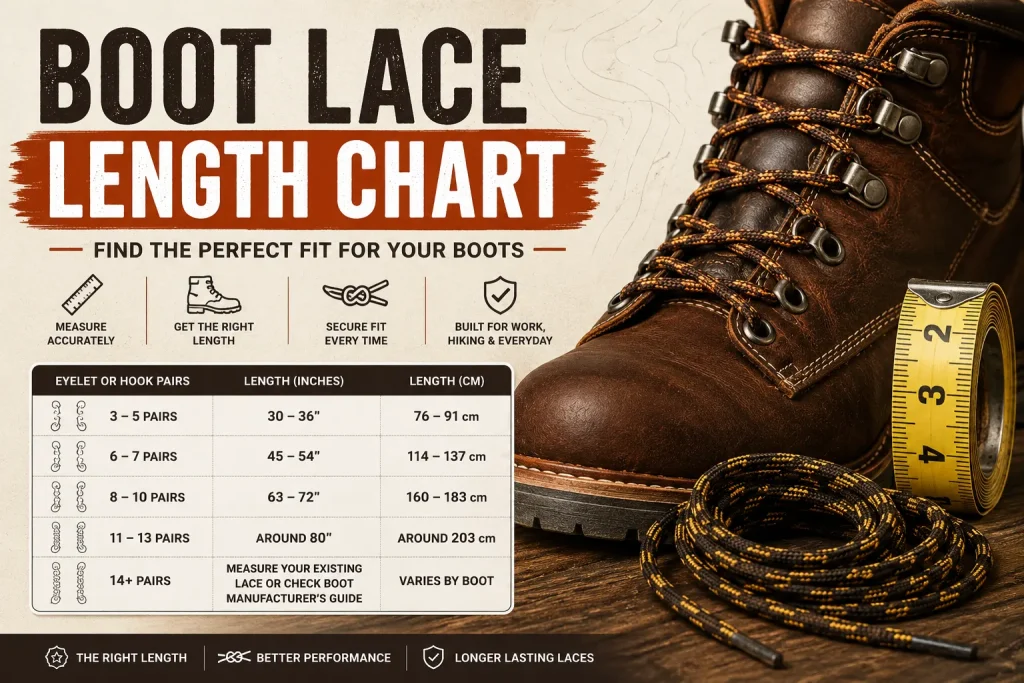
Boot Lace Length Chart by Eyelet Pairs
Use the chart below to estimate which lace lengths are worth considering. Count the eyelets and hooks on one side of your boot, including only the positions used by your normal lacing pattern.
| Eyelet or hook pairs | Starting length to consider | Length in centimeters |
|---|---|---|
| 3–5 pairs | 30–36 inches | 76–91 cm |
| 6–7 pairs | 45–54 inches | 114–137 cm |
| 8–10 pairs | 63–72 inches | 160–183 cm |
| 11–13 pairs | Around 80 inches | Around 203 cm |
| 14 or more pairs | Measure your existing lace or check the boot manufacturer’s guide | Varies by boot |
Important: These are approximate starting points, not a universal sizing standard. Published recommendations differ between manufacturers and boot designs. For example, Red Wing Stockholm lists 45–54 inches for boots with 6–7 eyelet pairs and 63–72 inches for 8–10 pairs. Danner also publishes specific lace lengths for its own boot designs. These examples illustrate why you should confirm the size against your particular footwear before ordering.
If your measurement falls between two listed sizes, consider your boot’s width, hook placement, lacing pattern, and preferred knot. The longest option is not automatically the best one.
How to Read a Boot Lace Size Chart
Before choosing a length, make sure you’re counting the eyelets correctly.
Eyelet pairs are the matching lacing positions on opposite sides of the boot at approximately the same height. For example, five holes on the left side and five on the right side represent five pairs, not ten.
Include speed hooks if your laces pass through them. These hooks contribute to the total lacing distance, just like regular eyelets.
Here’s a simple example: if your boot has five regular eyelet pairs and two additional pairs of speed hooks, you have seven lacing pairs in total. Start by comparing the 45–54-inch range, then check your original lace length or the manufacturer’s recommendation to narrow down your choice.
Remember that two boots with seven pairs can still need different lengths. Wide uppers, thick tongues, widely spaced hooks, and different lacing patterns can all affect the result.
Boot Lace Length by Boot Type
Boot style can help you narrow down your options, but it should not replace measuring or checking the manufacturer’s sizing advice.
| Boot type | What to consider when choosing length |
|---|---|
| Work boots | Count all the eyelets and speed hooks used. Taller work boots may require longer laces than ankle-height designs. |
| Hiking boots | Consider the boot’s height, width, hook spacing, and whether you use a standard or alternative lacing pattern. |
| Tactical-style boots | Tall shafts and multiple rows of hooks can increase the required lace length. |
| Casual and ankle boots | Start with the eyelet count, then compare the result with the original lace measurement. |
| Leather and heritage boots | Match the original length and check the lace’s shape and thickness against the boot hardware. |
There is no single lace length that works for every boot in any of these categories. Use the style as a clue, then confirm the size based on the actual lacing layout.
The Most Reliable Way to Find Your Boot Lace Length
If your existing laces fit comfortably, measuring one is usually the best starting point. It gives you a measurement based on your boot’s actual design rather than an estimate from a chart.
Method 1: Measure Your Existing Laces
- Remove one lace. Take it out of your boot so you can measure it from end to end.
- Lay it flat. Straighten it gently without pulling or stretching it.
- Measure tip to tip. Use a ruler or tape measure to record the full length, including the tips.
- Compare available sizes. Look for a replacement close to your measurement.
- Check the result. Make sure the new lace will leave enough length for your usual knot and fit comfortably through the eyelets or hooks.
If your current lace is worn, stretched, or already too short, don’t copy its length blindly. Use the chart as a starting point and consider whether your existing fit needs correcting.
Method 2: Use String if You Don’t Have an Old Lace
Lost both laces? You can still estimate the length you need.
Thread a piece of string through your boot using your usual lacing pattern. Leave enough material at both ends to form the knot you normally use. Remove the string, lay it flat without stretching it, and measure from end to end.
This method accounts for your boot’s actual spacing and lacing route, making it more useful than relying on the eyelet count alone.
Should You Choose Longer or Shorter Boot Laces?
If two sizes seem suitable, think about how you wear and tie your boots rather than automatically choosing one size up or down.
Consider a longer lace if:
- Your boots have wide uppers or widely spaced hooks.
- You use a lacing pattern that requires extra length.
- You prefer a larger bow or a double knot.
- Your existing laces are too short to tie comfortably.
Consider a shorter lace if:
- Your current laces leave excessive loose ends.
- Your boot has a compact lacing layout.
- You regularly tuck away excess lace and want a neater fit.
Always leave enough length to tie a secure knot. Loose ends that drag, snag, or interfere with movement are not ideal, particularly when wearing work or outdoor boots.
Common Boot Lace Sizing Mistakes
A few common mistakes can make an otherwise simple replacement harder than it needs to be.
- Counting both sides as separate pairs: Count the lacing positions on one side of the boot.
- Ignoring speed hooks: Include the hooks you actually use when counting lacing pairs.
- Choosing by boot size alone: Your shoe size does not reliably determine lace length. The lacing layout is a better guide.
- Assuming all boots of the same height need the same length: Eyelet spacing, boot width, and lacing style can change the amount of lace required.
- Forgetting lace thickness: A replacement that is too thick may not fit comfortably through narrow eyelets or hooks, even if its length is correct.
- Copying a poorly fitting lace: If the original is too short or too long, use a measurement method that accounts for the fit you actually want.
Frequently Asked Questions
Find the Right Replacement Boot Laces
Once you’ve worked out the approximate length, compare replacement laces by their available sizes, material, shape, thickness, and compatibility with your boots.
Visit our Best Boot Laces to explore our recommendations for work boots, hiking footwear, heavy-duty use, and leather boots.
The simplest approach is to measure a lace that fits well, use the chart to cross-check the size, and confirm the product dimensions before buying. A few minutes spent checking these details can save you from ordering a replacement that doesn’t fit.
Sizing references
This guide uses published manufacturer and retailer sizing guidance as reference points. Because recommendations vary by boot design, check the source most relevant to your footwear.
The references provide examples and sizing methods, not a single universal standard. Always confirm the specifications for your own boots and the replacement laces you plan to purchase.
Affiliate disclosure
Best Boot Laces may earn a commission from qualifying purchases made through affiliate links, at no additional cost to you. As an Amazon Associate I earn from qualifying purchases.